Costs
What Adds the Most Cost to a Deck? (Ranked by Impact)
The five biggest cost drivers on a Toronto deck, in rough order of impact: height off the ground, railing choice, decking material, site access, and stairs. Height is the sleeper: going from a ground-level platform to a walkout-height deck can add 30 to 60 percent to the structure before you've upgraded a single visible surface. Size matters too, obviously, but cost per square foot actually drops as decks get bigger, so size is the least interesting lever on this list.
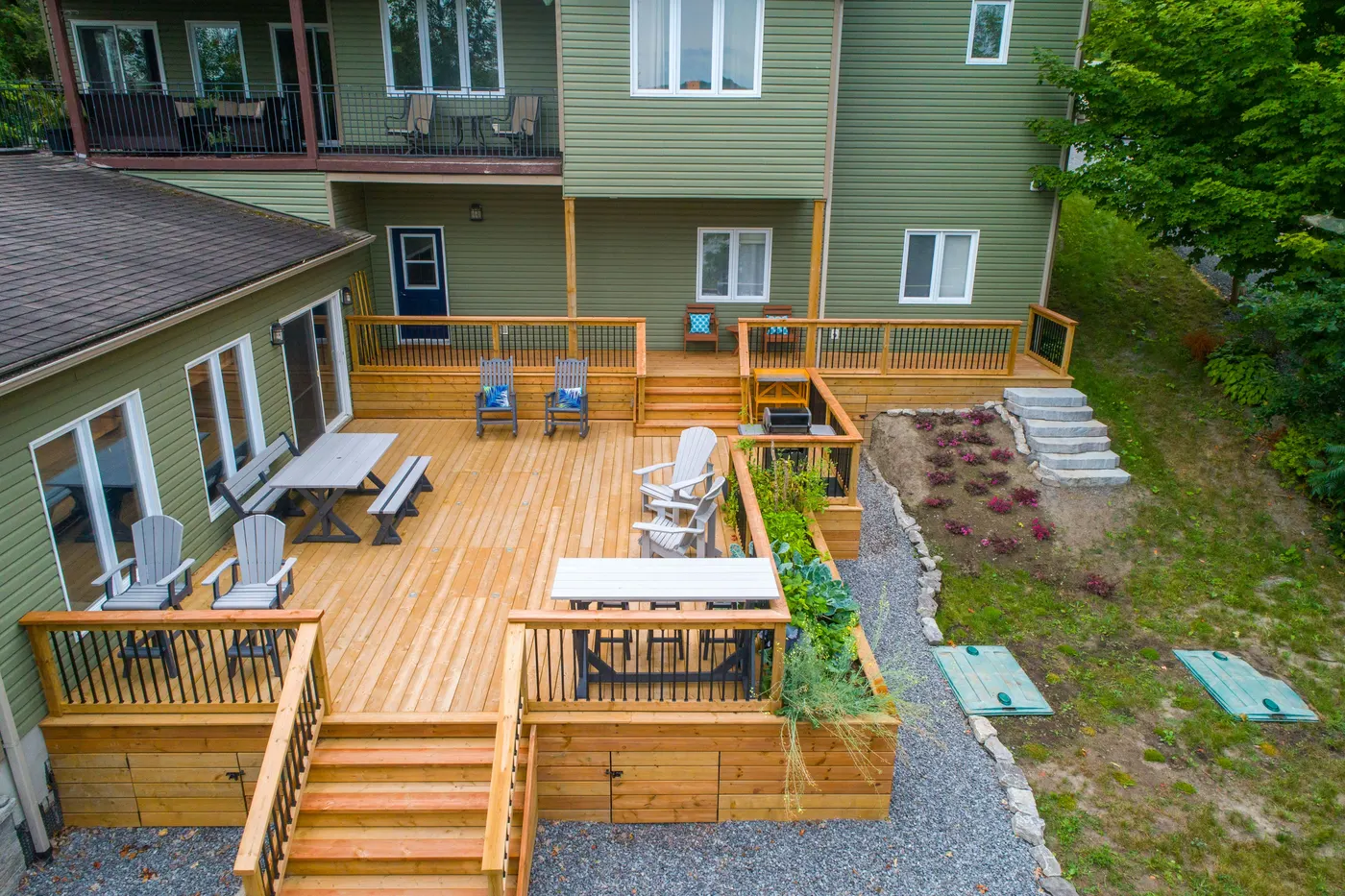
Ranked: where the money goes
1. Height ($2,000 - $10,000+ swing)
Every foot off the ground adds framing, longer posts, deeper engineering, and guard requirements. A ground-hugging platform needs minimal structure. A second-storey walkout needs engineered beams, substantial footings, guards, and a staircase, and often an engineer's stamp. Same square footage, wildly different builds.
2. Railings ($1,500 - $8,000 swing)
Required above 600 mm, and the spec range is enormous: pressure-treated wood pickets at the bottom, aluminum in the middle, frameless glass at the top at $150+ per linear foot. On a raised 12x16 deck with 50 linear feet of guard, railing choice alone can swing the project by several thousand dollars. Glass is beautiful and shows every fingerprint; aluminum is the value pick most clients land on.
3. Decking material ($5,000 - $10,000 swing on a mid-size deck)
Covered fully in our composite vs. pressure-treated comparison: pressure-treated $30-50/sq ft installed, cedar $50-75, composite $60-90, PVC $80-110. The framing underneath is similar; you're paying for the surface and its maintenance profile.
4. Site access ($1,000 - $5,000 swing)
If a bobcat can drive to the build site, excavation and material handling are fast. If every bag of concrete and 16-foot board travels through your house or down a shared Toronto laneway, labour hours multiply. Downtown lots routinely price 15-25 percent above suburban equivalents for identical decks. Tree protection zones and ravine slopes add more.
5. Stairs ($800 - $4,000+)
A basic 3-step set is cheap. A full-height staircase from a walkout deck is a small structure of its own: stringers, landings, guards on both sides, and code rules on every riser and tread. Wraparound and cascading stairs are beautiful and priced like it.
The features people forget to budget
- Skirting (finishing the underside): $500 - $2,500
- Privacy screens: $500 - $3,000, and legal to 2.0 m above the deck surface in Toronto
- Lighting: $300 for solar caps to $2,500+ for wired low-voltage systems
- Built-in benches and planters: $500 - $2,000 each
- Permits, drawings, survey: $200 - $2,500 depending on what you already have (details in our permit cost guide)
Where to save without regret
- Simplify the shape. Rectangles are the cheapest square footage in construction. Every corner, angle, and level change adds framing and waste.
- Go aluminum, not glass. Railings you'll never maintain, at half the glass price.
- Keep it low if you can. If your walkout is only a few steps up, a lower deck with a landing can dodge major structure and sometimes the guard requirement entirely.
- Build off-season. Winter-booked projects for spring install are the cheapest calendar slot.
Where not to save
Footings, framing, ledger flashing, and hardware. Nobody sees them, and they're the entire difference between a deck at year 15 and a rebuild at year 8. Cut the visible extras before you let anyone cut the structure.
Where we actually stand on all of this: cost is the priority for nearly every client right now, and we treat our job as getting them the closest version of what they want at the best possible price, not maximizing the invoice. In-deck lighting systems are a good example. They're fantastic and genuinely high-end, and we'll happily install them, but if a client isn't going to get real benefit from one, we'd rather see that money go into the structure or stay in their pocket. We'll also adjust things on the fly when a better-value path shows up mid-build, done properly through a change order. Nobody here is driving a Lamborghini; my own car is twenty years old. We're trying to end up with a great deck and a client who'd hire us again, and that's easier when every dollar in the quote is doing something.
FAQ
Does a bigger deck cost more per square foot? Less, usually. Fixed costs (mobilization, permit, footings pattern) spread across more area. A 300 sq ft deck is rarely 1.5x the price of a 200 sq ft deck.
How much does a second-storey deck cost vs. ground level? Commonly 40-80 percent more for the same footprint once structure, guards, and stairs are counted.
Are curves worth it? Aesthetically, sometimes. Financially, never: curved framing and picture-framed curved decking can add 20-40 percent. Get the wow with a picture-frame border and good lighting instead.
What's the single best value upgrade? Aluminum railings on a composite deck. Maximum visual and maintenance payoff per dollar.
See how each choice moves your number: our estimator lets you toggle material, railings, and height for your exact size. Get your estimate →